Key Takeaways
1. This is no longer a BBMP circular
If you still hear 'BBMP parking charges', translate it. Civic control of Greater Bengaluru moved to the Greater Bengaluru Authority from October 2025. The draft now on the table is the Greater Bengaluru Authority (Parking) Rules, 2026, notified by the Karnataka Urban Development Department on 11 August 2026, with 30 days for objections before the Gazette draft can be finalised.
The policy intent is blunt: almost no public parking stays free. Bicycles and autorickshaw stands are the exceptions. Everything else — the kerb outside a house, the slot on a commercial stretch, even a monthly off-street bay — is meant to carry a published minimum fee.
2. What it costs to park on the road
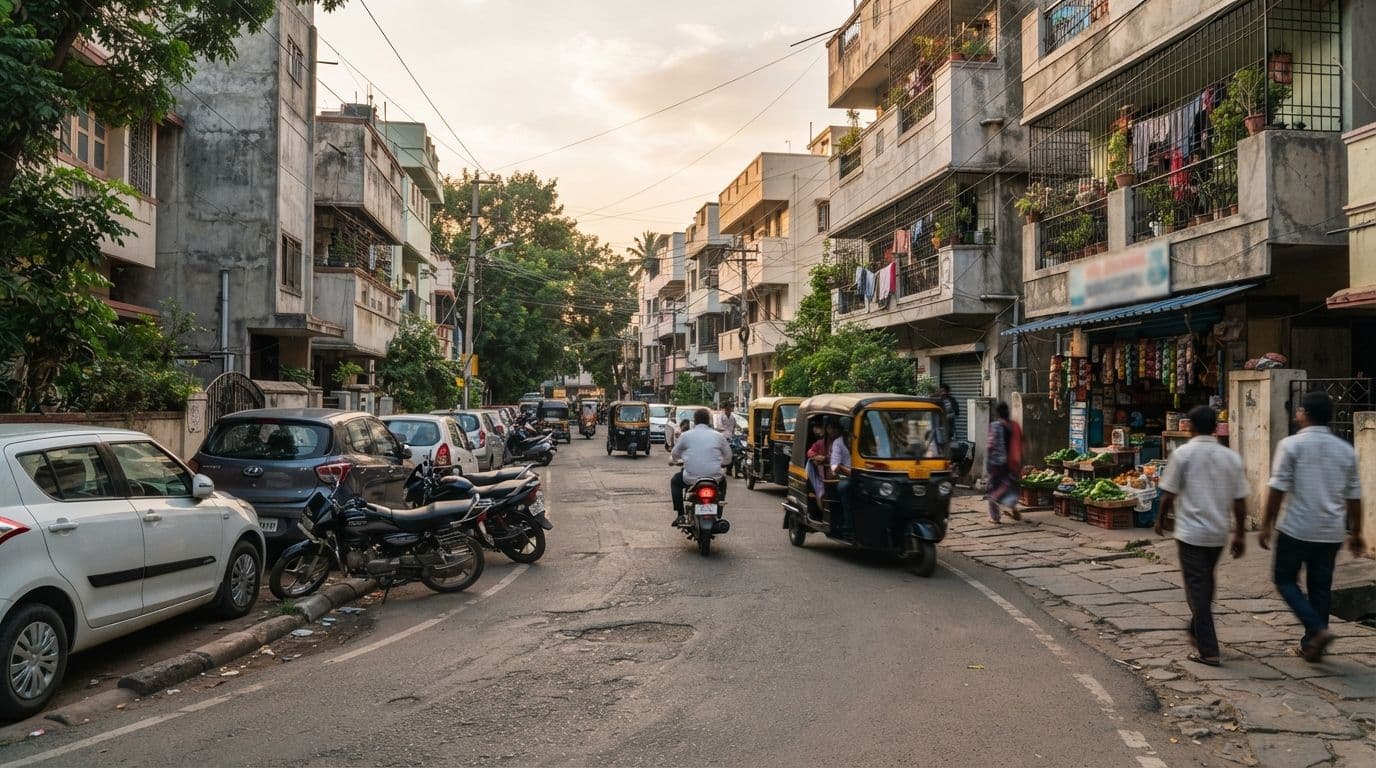
On-street hourly rates are set by road category. Category A is a commercial road that pulls people from across the city. Category B pulls from surrounding neighbourhoods. Category C is mostly local catchment.
- Category A: two-wheelers Rs 40/hour, cars/LMVs Rs 80/hour.
- Category B: two-wheelers Rs 30/hour, cars Rs 60/hour.
- Category C: two-wheelers Rs 20/hour, cars Rs 40/hour.
Off-street is deliberately cheaper so drivers leave the carriageway: cars Rs 20–40 an hour, two-wheelers Rs 10–20, with monthly off-street passes from Rs 1,000 to Rs 4,000. After two hours on-street, rates are meant to rise exponentially if an off-street option is nearby. Peak/off-peak differentials are allowed, but not live surge pricing — the swing cannot exceed 1.5 times.
3. The number that hit homeowners: Rs 15,000 to Rs 25,000 a year
Residents who park on a public road outside the house would need an annual residential parking permit. The draft floor is Rs 15,000 for a hatchback, Rs 20,000 for a sedan and Rs 25,000 for an SUV, plus an administrative fee the GBA Chief Commissioner will notify. Permits last one year, attach to a specific resident and vehicle, and are only for designated roads within walking distance of that home.
Two conditions matter more than the sticker price. First, a permit is only for owners whose building already meets minimum parking in the building bye-laws. Park on the road because the apartment never built its basement quota, and it can be treated as illegal even if you are willing to pay. Second, residential parking is not meant for arterial and sub-arterial roads. Collector roads need 6 metres left for traffic and 1.8 metres of clear footpath on both sides after a car is parked. Local roads need 4 metres for traffic and 1.8 metres of footpath on at least one side.
4. Where you will not be allowed to park at all
Parking is banned on the main carriageway of arterial roads that GBA marks as high-density corridors. Peak-hour bans can be added on other arterials by traffic police. Footpath parking is prohibited. On-street parking is barred within 150 metres of Metro and suburban-rail stations at first — city corporations can push that to 500 metres — and at least 25 metres from junctions and bus-stop entries. Autos and taxis cannot wait within 25 metres of those entries. Pick-up and drop-off is five minutes, designated points only.
Draft fines: Rs 500 for a car and Rs 300 for a two-wheeler parked illegally on the road; Rs 1,000 and Rs 600 for footpath parking. Parking outside the permitted zone with a valid permit still counts as a violation. Marshalls designated by the corporation would check residential permits and pass violations to police.
5. What this does to a property decision
For an apartment buyer, the first question is no longer only 'is there a slot in the basement?' It is whether that slot is bye-law compliant, because non-compliant buildings cannot lean on a roadside permit. Independent-house streets that currently function as free overnight parking become a recurring cost, or a towing risk, if the draft holds.
Commercial and mixed-use stretches on MG Road-class Category A roads would see the highest hourly kerb rates and, if The Hindu's reading is right, a doubling on the busiest commercial belts versus today's practice. Metro-adjacent shops and offices lose the informal 150-metre kerb that commuters use today. The flip side in the same draft: vacant private plots used as organised off-street parking can get a property-tax exemption, and corporations are told to build more off-street capacity on unused civic land and around Metro, bus and suburban-rail stations.
6. It is still a draft — act like the numbers are real anyway
Objections go to the Additional Chief Secretary, Urban Development Department, Vikasa Soudha, within the 30-day window from the 11 August Gazette publication. Nothing is notified as final yet. For a live transaction, treat the draft as the direction of travel: price in a permit or a basement slot, check bye-law parking on the sanctioned plan, and do not assume the road in front of the gate is a free accessory to the sale.
In Conclusion
Bengaluru is not inventing paid parking. It is trying to make the kerb expensive enough that basement slots, vacant-plot lots and short stays become the default. The numbers that will change a sale conversation are the annual roadside permit — especially Rs 25,000 for an SUV — and the rule that a building which never built its sanctioned parking cannot buy its way onto the street. Until the draft is notified, treat every listing that 'has plenty of road parking' as a cost and a compliance item, not an amenity.
Frequently Asked Questions
Related Real Estate Services & Topics
Need Local Property Assistance?
Get Expert Guidance on Bengaluru Real Estate
Whether you are buying, selling, leasing, or verifying title deeds, our advisory team is here to assist.
