Key Takeaways
Free tools for this topic
Bengaluru’s rental market at a glance After the sharp rent rises of 2024–25, Bengaluru’s rental market is cooling down and splitting by zone. Growth is now modest, at about 0–2% a quarter, and incoming supply is giving tenants more choice. Where you invest or rent now matters more than ever.
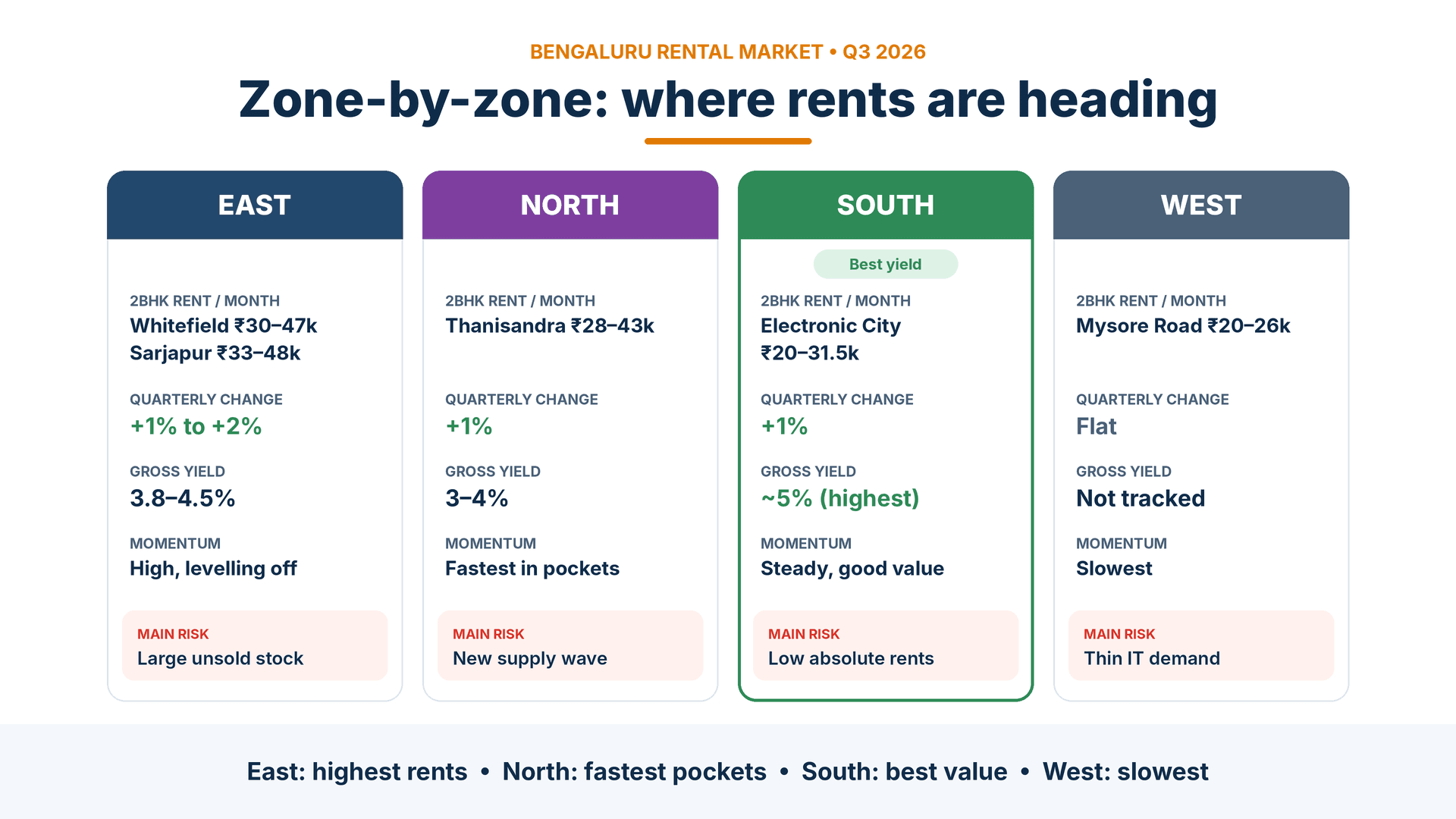
Zone-by-zone comparison (Q3 2026) East: highest rents, but growth is levelling off East Bengaluru is the city’s main IT rental zone, and it has had the steepest long-term rise. According to ANAROCK, average monthly rent on Sarjapur Road rose 76% over three years, from ₹21,000 to ₹36,900.
Rents vary across the zone: about ₹38k in Whitefield, ₹35k in Bellandur and ITPL, ₹26k in Varthur and ₹22k in KR Puram.
Supply risk: East accounted for 44% of sales and 48% of unsold stock in Q3 2026. As these homes are completed, many will come onto the rental market, which should slow rent growth here first.
North: fastest-growing in pockets, with a supply wave ahead Rents in North Bengaluru vary widely: about ₹30k in Hebbal, ₹24k in Jakkur and ₹22k in Hennur, but only about ₹15–16k in Devanahalli and Bagalur.
A blog citing ANAROCK reports that Thanisandra Main Road and Marathahalli-ORR recorded the highest rental growth, 24% year on year, for a 1,000 sq ft 2BHK. That figure comes from a secondary source.
Supply risk: North launched the largest share of new supply (46%). The airport area and the upcoming Blue Line support demand, but heavy new supply is likely to limit rent growth on the outskirts.
South: steady, good value and high yields Electronic City is the most affordable IT rental corridor and has the best gross yield, around 5%. The Yellow Line (open since 2025) and now the Pink Line add to tenant demand. In Q2, South was the only zone where sales grew both quarter on quarter and year on year.
South is really two markets:
- Core South (Koramangala, HSR Layout, JP Nagar, BTM Layout): expensive, with too few homes available to rent.
- Outer South (Electronic City, Begur, Kanakapura Road): mid-priced, with steady rent rises.
West: cheapest and slowest Mysore Road rents stayed flat in both Q2 and Q3 2026, at ₹20–26k. West has a smaller share of sales, and its unsold inventory rose both year on year and quarter on quarter.
Demand comes mainly from families and local businesses rather than IT employers. Established areas such as RR Nagar, Vijayanagar and Rajajinagar hold their rents well, but growth is limited. ANAROCK tracks only one micro-market here, so West has the thinnest data of the four zones.
What this means for you
- Landlords in East and North: Set realistic renewal increases of about 5–8%, not the double-digit rises of 2024–25. With more supply coming, tenants have more choice.
- Rental investors: South gives the best rent relative to purchase price, especially Electronic City and metro-connected areas such as Hulimavu, BTM Layout and JP Nagar, near the Pink and Yellow line interchange.
- Tenants: West and outer North are where rents are most affordable. For a similar flat, rents there are roughly 40–50% lower than in East.
- What to watch: Completions of East’s unsold stock, and the opening of the Blue Line from ORR to the airport. The Blue Line is likely to change the East–North rent gap more than anything else in 2027.
In Conclusion
Bengaluru’s rental market has moved from rapid growth to a more balanced phase. East still has the highest rents but faces a supply overhang. North is growing in pockets but has heavy new supply ahead. South offers the best mix of value and yield, and West stays affordable with modest growth. For landlords, that means realistic renewals. For investors, metro-connected South locations stand out. For tenants, there are good deals in West and outer North. Get local advice before you buy, rent or renew.
Frequently Asked Questions
Related Real Estate Services & Topics
Need Local Property Assistance?
Get Expert Guidance on Bengaluru Real Estate
Whether you are buying, selling, leasing, or verifying title deeds, our advisory team is here to assist.
