Key Takeaways
Free tools for this topic
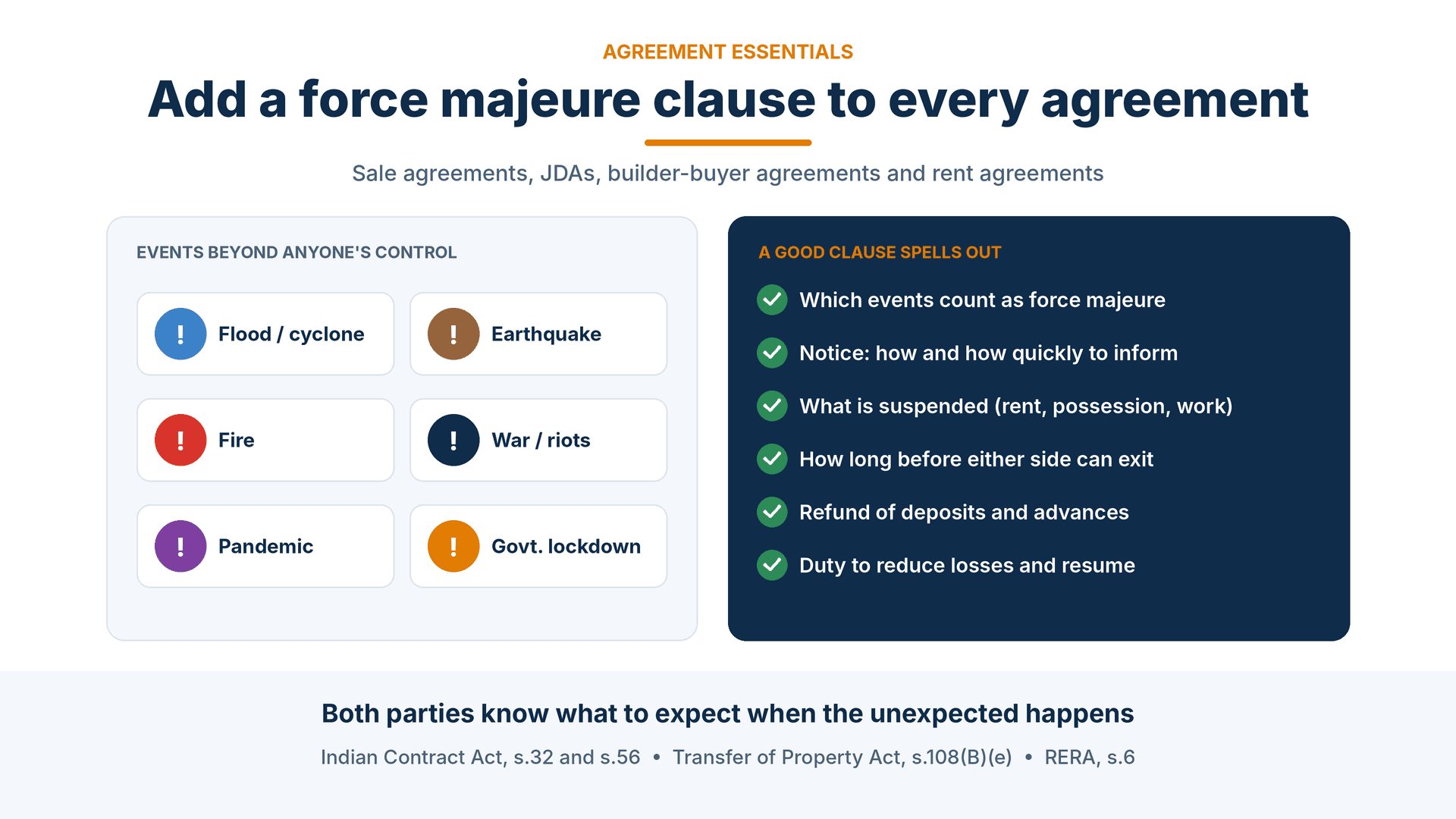
What is force majeure? “Force majeure” is French for “superior force”. It covers events that are beyond the parties’ control, couldn’t reasonably have been foreseen or prevented, and stop a party from performing its obligations. Common examples:
- Natural calamities and acts of God: flood, cyclone, earthquake, landslide, drought, lightning
- Fire and explosion
- War, invasion, terrorism, riots and civil unrest
- Epidemics and pandemics
- Government action: lockdowns, prohibitory orders, changes in law that make performance impossible
Why a force majeure clause matters
- It sets expectations in advance. Both parties know what happens if the unexpected strikes, before it happens.
- It prevents disputes. Without a clause, parties argue over whether the contract still stands, who bears the loss and whether money must be refunded.
- It protects both sides. The affected party isn’t treated as being in breach, and the other party gets clear notice, timelines and exit rights.
- It gives you more control than the general law. The doctrine of frustration is narrow and all-or-nothing. A well-drafted clause can suspend obligations, extend timelines or allow an orderly exit.
- It saves time and money. Clear terms mean fewer court cases.
Why it matters in property agreements
- Sale agreements: Covers delays in registration, loan disbursement or approvals caused by lockdowns or disasters, and sets whether the advance is refunded or the deadline extended.
- Builder-buyer agreements: Defines which events can delay possession and for how long, so buyers aren’t left with open-ended delays.
- Joint development agreements: Protects both landowner and developer when construction is stopped by events beyond their control.
- Rent agreements: Sets out what happens to rent if the home or shop becomes unusable, for example after a flood, fire or a long lockdown, and how the security deposit is refunded if the tenancy ends early.
The law on force majeure in India
1. Section 32, Indian Contract Act, 1872: contingent contracts If your agreement has an express force majeure clause, it is generally treated as a contingent contract under Section 32. The clause itself decides the outcome. In Energy Watchdog v. CERC (2017), the Supreme Court held that express clauses are governed by Section 32, and that a rise in costs alone doesn’t make performance impossible.
2. Section 56, Indian Contract Act: doctrine of frustration If there’s no clause, a party can argue that the contract has become impossible to perform and is therefore void under Section 56. In Satyabrata Ghose v. Mugneeram Bangur (1954), the Supreme Court explained that “impossible” includes cases where the very purpose of the contract is defeated. But the bar is high, and the result is all-or-nothing: the contract ends.
3. Section 108(B)(e), Transfer of Property Act, 1882: leases For leases, the Supreme Court has held that Section 56 doesn’t apply to a completed lease (Raja Dhruv Dev Chand v. Harmohinder Singh, 1968). Instead, under Section 108(B)(e), if the property is wholly destroyed or made substantially and permanently unfit by fire, tempest, flood, violence of an army or mob, or another irresistible force, the tenant may choose to void the lease. Temporary disruption doesn’t automatically suspend rent. That’s why an express clause matters so much in rent agreements.
4. RERA, 2016: real estate projects Under Section 6 of RERA, a project’s registration can be extended in cases of force majeure, defined as war, flood, drought, fire, cyclone, earthquake or any other natural calamity affecting the project’s development. During COVID-19, project timelines were extended across states by treating the pandemic as force majeure.
5. How courts read these clauses
- Clauses are read strictly, so the event must fall within the clause’s wording.
- The event must actually cause the non-performance.
- Pre-existing defaults aren’t excused. In Halliburton Offshore v. Vedanta (Delhi High Court, 2020), the court held that COVID-19 couldn’t excuse a party that was already in breach before the pandemic.
- The affected party must usually give notice and take reasonable steps to reduce losses.
What a good force majeure clause should include
Element
What to specify
Events covered
A clear list, plus “any other event beyond reasonable control”
Notice
How and within how many days the affected party must inform the other
Effect
Which obligations are suspended (rent, possession, construction, payment)
Duration
How long suspension can last before either party can end the contract
Money
Rent waiver or reduction, refund of advance or security deposit
Mitigation
Duty to reduce losses and resume as soon as possible
Exclusions
Events that aren’t covered, such as financial hardship or price rises
Sample force majeure clause for a rent agreement
“Neither party shall be liable for failure or delay in performing its obligations due to events beyond its reasonable control, including flood, earthquake, fire, cyclone, epidemic or pandemic, war, riots, terrorism, or any order of the government or a competent authority (“Force Majeure Event”). The affected party shall notify the other in writing within 7 days. If the premises become wholly or substantially unfit for use due to a Force Majeure Event, rent shall be suspended for that period. If such an event continues for more than 60 days, either party may terminate this agreement by 15 days’ written notice, and the Lessor shall refund the security deposit, less any lawful dues, within 30 days of handover of the premises.”
This is a sample only. Adapt it to your agreement with legal advice.
In Conclusion
No one can predict the next flood, pandemic or lockdown, but every agreement can be ready for it. A clear force majeure clause protects both parties, prevents disputes and sets out what happens to rent, possession, payments and deposits when the unexpected strikes. Whether it’s a sale agreement, JDA, builder-buyer agreement or a simple 11-month rent agreement, make sure the clause is in there and drafted properly.
Disclaimer: This article is for general information only and is not legal advice. Consult a lawyer to draft or review your agreement.
Frequently Asked Questions
Related Real Estate Services & Topics
Need Local Property Assistance?
Get Expert Guidance on Bengaluru Real Estate
Whether you are buying, selling, leasing, or verifying title deeds, our advisory team is here to assist.
