Key Takeaways
Free tools for this topic
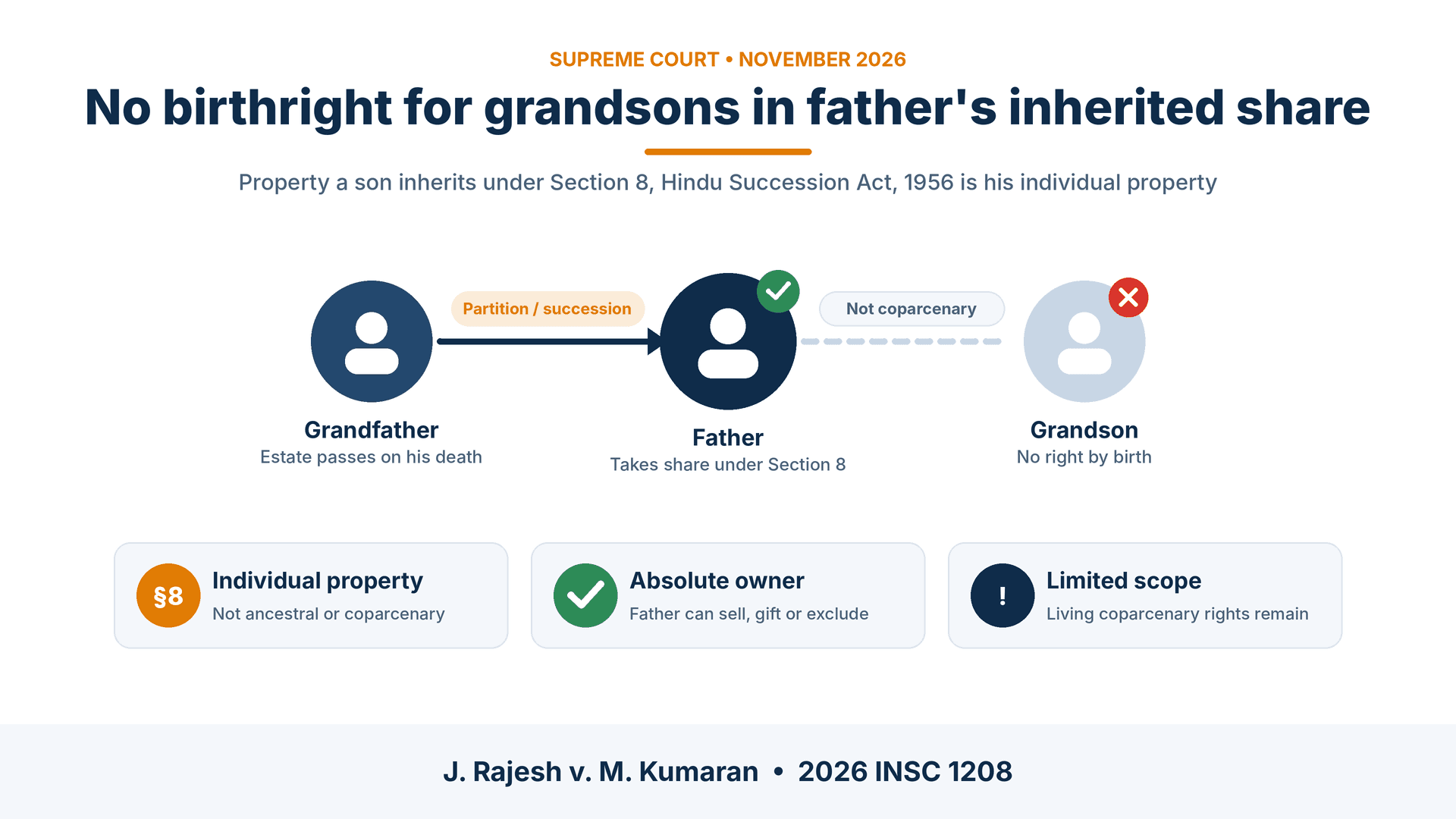
The ruling in brief In November 2026, the Supreme Court of India held that property a son inherits from his father’s estate under Section 8 of the Hindu Succession Act, 1956 belongs to him as an individual. It is not ancestral or coparcenary property. As a result, the son’s own son, the grandson, does not acquire any right in that property by birth.
A bench of Justices Augustine George Masih and Sunita Agarwal delivered the judgment in J. Rajesh (Minor) v. M. Kumaran (Dead) through LRs (Civil Appeal No. 7020 of 2012, 2026 INSC 1208). It ended a dispute that began in 1997.
Background of the case
- The grandfather died intestate, meaning without a will.
- His daughter filed a partition suit in 1993. A compromise decree dated 3 February 1994 allotted a 1,811 sq ft parcel to the appellant’s father.
- The appellant was born on 6 January 1994, after his grandfather’s estate had already passed to the Class I heirs.
- In April 1997, the father sold the parcel to two buyers.
- The same year, the grandson sued as a minor, claiming a half share as ancestral property. The trial court ruled in his favour, but the appellate court reversed that decision. The Supreme Court has now dismissed his appeal.
What the Supreme Court held
- Section 8 is self-contained. When a Hindu man dies without a will, his property passes to his Class I heirs, such as his sons, daughters and widow. A grandson is not a Class I heir while his father is alive.
- The heir becomes the absolute owner. A son who inherits under Section 8 holds the property in his own right, not as head (karta) of a joint family for his sons.
- No birthright. Because the property is individual, not coparcenary, a grandson born later gets no right in it by birth.
- Partition shares are individual too. When a son or daughter receives a share through partition of such an estate, they own it absolutely and can deal with it as they choose.
- The court confirmed existing law. It relied on CWT v. Chander Sen (1986), Yudhishter v. Ashok Kumar (1987), Bhanwar Singh v. Puran (2008) and Radha Bai v. Ram Narayan (2020).
What the ruling does not do The judgment does not abolish birthrights in a Mitakshara coparcenary that still genuinely exists. Under Section 6 of the Act, property that remains coparcenary is still governed by coparcenary rules. Whether a particular property counts as coparcenary or individual depends on its history: when it was acquired, how it passed down, and whether it was partitioned.
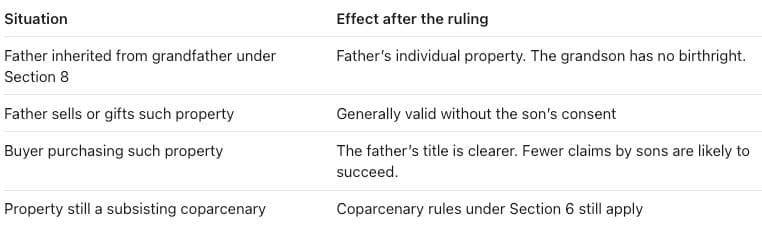
For buyers: Due diligence should trace how the seller acquired the property, whether by Section 8 succession, partition, gift or will. That decides whether family members can make claims.
For sellers and families: Owners who inherited under Section 8 can plan sales, gifts or wills with more certainty. Families should still keep partition deeds, succession certificates and mutation records in order. Sources:
In Conclusion
The Supreme Court has reaffirmed a clear principle: what a son inherits from his father’s estate under Section 8 of the Hindu Succession Act is his own. That brings certainty for owners, buyers and lenders, and limits claims by grandsons to property that is still genuinely coparcenary. Every family’s property history is different, so get legal advice and do a careful title check before you buy, sell or divide inherited property.
Disclaimer: This article is for general information only and is not legal advice.
Frequently Asked Questions
Related Real Estate Services & Topics
Need Local Property Assistance?
Get Expert Guidance on Bengaluru Real Estate
Whether you are buying, selling, leasing, or verifying title deeds, our advisory team is here to assist.
