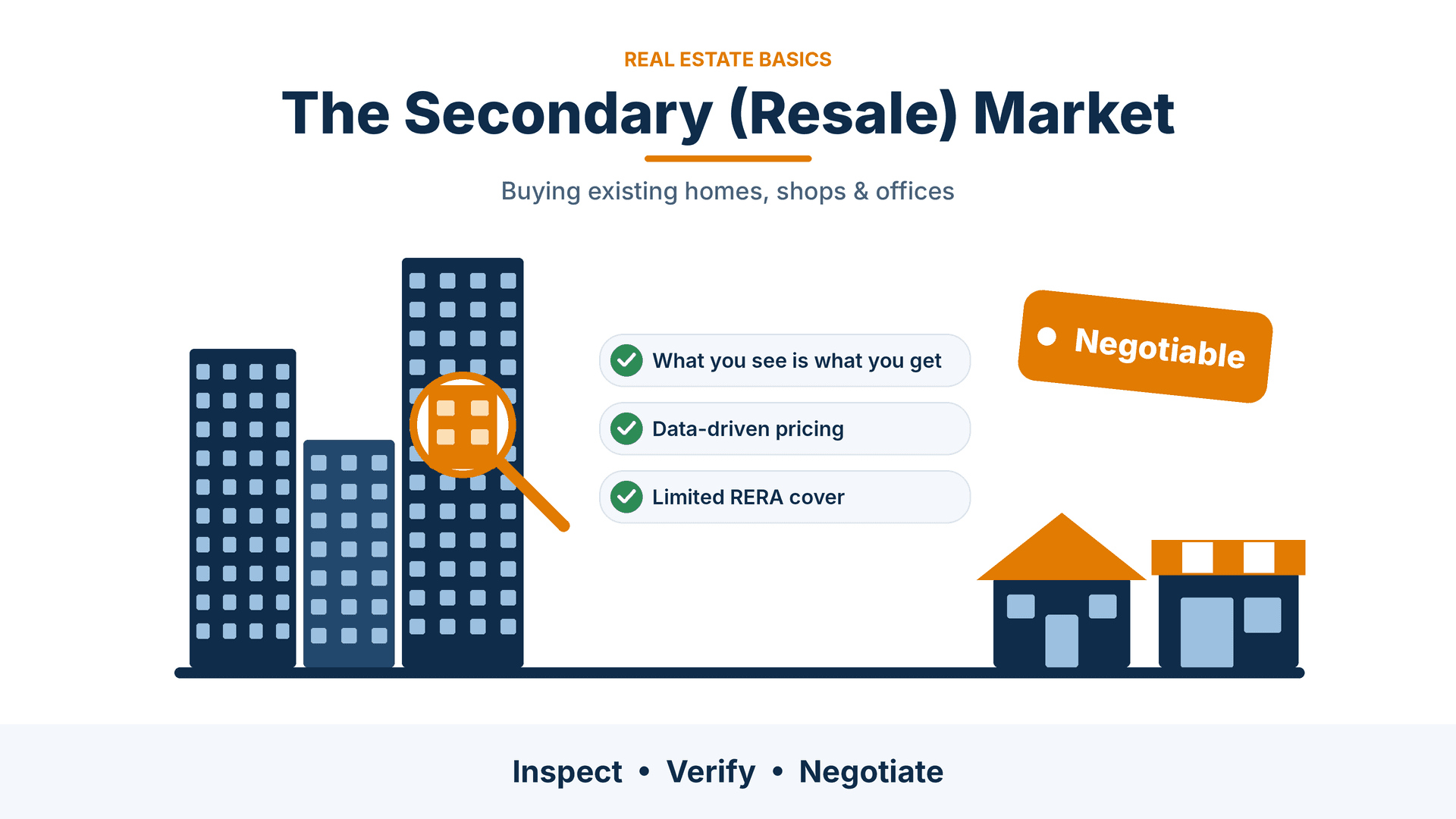
Key Takeaways
Free tools for this topic
What is the secondary real estate market? The secondary real estate market, also called the resale market, is where existing residential or commercial properties are bought and sold between owners rather than bought directly from a developer. A resale flat, an older independent house and a previously owned shop or office all belong to this market.
The primary market sells new or under-construction projects straight from builders. The secondary market deals in properties that already exist, have a history and usually have someone living in or using them.
Key features of the secondary market
1. A proven market: what you see is what you get In the primary market, buyers often depend on brochures, sample flats and a developer’s promises about what will be delivered. A resale property is already built and in use, so there are no ifs and buts. Before you commit, you can physically inspect:
- The actual unit you are buying
- Its condition, including construction quality, leaks and maintenance
- The neighbourhood and how it has developed
- Connectivity to roads, transit, schools and workplaces
- Amenities and the quality of the society or association
This cuts down the uncertainty that comes with buying off-plan.
2. A data-driven market: the data speaks for the customer Resale properties sit in established locations with a track record. Buyers can compare recent sale prices, rents and price trends for similar homes in the same building or area. That lets you judge value from evidence rather than projections.
3. Limited RERA coverage The Real Estate (Regulation and Development) Act, 2016 mainly governs new projects sold by developers. Resale deals between individuals generally fall outside its protection. Buying a unit in a RERA-registered project that is still under construction can be an exception, because the developer’s obligations may still apply. For most resale purchases, the responsibility for due diligence rests with you. Key checks include:
- Title deed and the chain of ownership documents
- Encumbrance certificate
- Khata and property tax receipts
- Approved building plan and occupancy certificate, where applicable
- Society NOC and dues clearance
4. Unorganised and fragmented There is no central exchange for resale property. Deals happen through individual owners, local brokers and online property portals such as MagicBricks, 99acres and Housing.com. Listings can be duplicated, out of date or inaccurate, so working with a reliable advisor and checking everything independently makes a big difference.
5. Negotiable, non-standard pricing There is no fixed price list. Prices depend on:
- Location
- Age of the property
- Floor
- Condition
- The seller’s urgency
The final price is settled by negotiation. This leaves room for bargains, but it also makes prices less transparent, which is another reason to rely on market data.
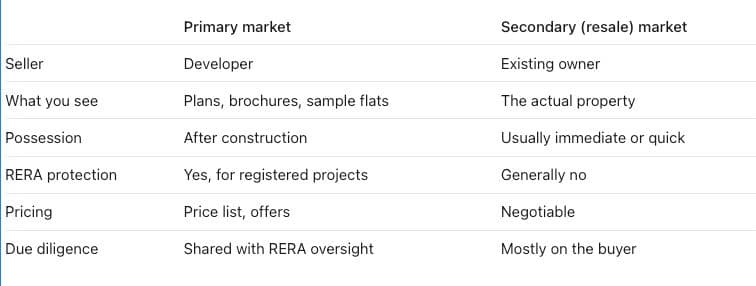
In Conclusion
The secondary market gives buyers something the primary market can’t: certainty about what they are buying. You can see the property, check the neighbourhood and negotiate based on real data. With limited RERA protection and a fragmented market, careful due diligence is essential. Inspect the property, verify the documents and negotiate with confidence, ideally with an experienced property advisor at your side.
Watch this quick video for the summary : https://www.youtube.com/shorts/TLpKEeQ2XDU
Frequently Asked Questions
Related Real Estate Services & Topics
Need Local Property Assistance?
Get Expert Guidance on Bengaluru Real Estate
Whether you are buying, selling, leasing, or verifying title deeds, our advisory team is here to assist.
